Tuesday, March 16, 2010

Thai protesters threaten to throw blood at official buildings

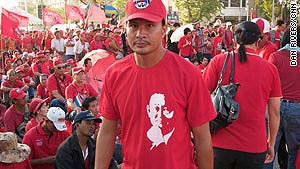
Bangkok, Thailand (CNN) -- Prime Minister Abhisit Vejjajiva rejected protesters' demands Monday that he call an early election and dissolve parliament, saying on national television that he would listen to the protesters but would not be forced to accede to their demands.
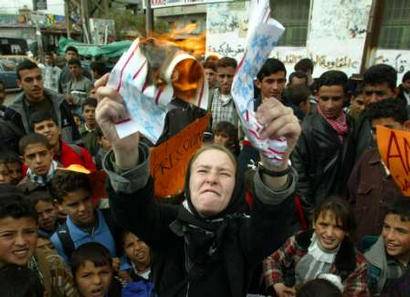
The rejection came after another largely peaceful day of demonstration during which thousands of red-shirted protesters called for a blood bath of sorts -- organizing a blood drive and threatening to spatter hundreds of liters of donated blood over government buildings and the prime minister's residence.
Abhisit spent much of Monday morning holed up in a safe house in a military compound, which was surrounded by protesters. He left by helicopter in order to survey the situation, after which the protesters left the site.
The protests, which were expected to continue Tuesday, have hurt the economy. The nation's tourism minister estimated the demonstrations might have resulted in a 20 percent drop in tourists. The impact on Chinese visitors appears to have been greater, with the Chinese Chamber of Commerce reporting a 50 percent cancellation rate.
"Red shirts" rally in Bangkok: Share your photos
The protesters, who are trying to bring down the prime minister's administration, announced the blood drive an hour after Abhisit ignored a demand by the "red shirts" -- named for their clothing -- to dissolve parliament by noon Monday.
Nattawut Saikua -- one of the leaders of the anti-government United Front for Democracy Against Dictatorship -- said the protesters will collect 1,000 liters (1 million cubic centimeters) of blood Tuesday and then throw it on the grounds of the Government House, which houses ministerial offices.

If Abhisit still refuses to dissolve parliament, the demonstrators said, they will collect another 1,000 liters of blood the next day and splash it on the headquarters of the ruling party.
The next day, they will collect 1,000 more liters and target the prime minister's residence, the demonstrators said.
The anti-government demonstrations began Friday. By Sunday, tens of thousands of protesters had poured into the center of Bangkok. The rallies have been largely peaceful. Abhisit said Monday that his government will not use force to quell the demonstrations.
Army Col. Sansern Kaewkumnerd said a number of grenades were tossed from a side street into the 11th Infantry headquarters, where the Center for the Administration of Peace and Order is coordinating the government response to the protests.
Two soldiers were hurt, the colonel said. The protesters are supporters of former Prime Minister Thaksin Shinawatra, who was ousted in a bloodless military coup in 2006.
Thaksin was the only Thai prime minister to serve a full term and remains hugely popular. He fled the country in 2008 while facing trial on corruption charges that he says were politically motivated.
The protesters say Abhisit was not democratically elected and have demanded that he call new elections. About 50,000 security forces were mobilized ahead of the protests and additional soldiers were guarding Abhisit.
Since Thaksin's ouster, Thailand has endured widespread political unrest that has pitted Thaksin loyalists against Abhisit supporters.
Two people were killed and at least 135 wounded in riots in April 2009 when protesters clashed with demonstrators supporting the government.

Police arrest 69 suspected members of Georgian-run mafia


Madrid, Spain (CNN) -- Police across Europe arrested 69 suspected members of a Georgian-run mafia, including 24 in Spain, which was leading the investigation, a National Court spokeswoman told CNN Monday.
Other arrests were in Germany, Austria and Switzerland, whose prosecutors worked with their Spanish counterparts on the case. There were also a few arrests in France and Italy, said the spokeswoman, who by custom is not identified.
The suspects, wanted for drug trafficking, extortion and money laundering, and in a few cases for murder plots, were thought to have operated at a level close to the street, controlling local mafia networks, she said -- they are not thought to be high-style mafia kingpins living in mansions and surrounded by luxuries.
Some Spanish media reported the suspects were linked to a Russian mafia, but the court spokeswoman said investigators had told her it was Georgian-run.
In Spain, the national police worked with regional police in Catalonia and the Basque region to make the arrests, mainly in the Barcelona and Valencia areas, she said.
There has long been speculation that mafias were involved in money laundering through Spain's housing and real estate bubble along the Mediterranean coast, where second homes were built for vacationers from Spain and northern Europe.
Tens of thousands of these homes remain unsold or unfinished in the economic downturn.
Numerous local Spanish politicians have been arrested on suspicion of accepting bribes or kickbacks to permit rampant construction that far exceeded demand.

Monday, March 15, 2010

Anti-government protesters flood Bangkok

Bangkok, Thailand (CNN) -- Tens of thousands of protesters poured into the center of Bangkok Sunday, bringing the city to a virtual standstill in an effort to topple the Thailand government.
The anti-government demonstrations began Friday and were expected to reach their peak over the weekend as a Monday ultimatum -- set by the "red shirt" opposition protesters -- approached for Prime Minister Abhisit Vejjajiva to leave office.
Protesters, without giving specifics, have warned that they will increase pressure if the ultimatum is not met. So far, the rallies have been largely peaceful.
The protesters are supporters of former Prime Minister Thaksin Shinawatra, who was ousted in a bloodless military coup in 2006. Thaksin was the only Thai prime minister to serve a full-term in office and remains hugely popular.
The protesters say that current Prime Minister Abhisit was not democratically elected and have demanded that he call new elections.
About 50,000 security forces were mobilized ahead of the protests and additional soldiers were guarding Abhisit, who is at a safe house at a military compound.
Since Thaksin's ouster, Thailand has endured widespread political unrest that has pitted Thaksin loyalists against Abhisit's supporters. Two people were killed and at least 135 wounded in riots in April 2009 when protesters clashed with demonstrators supporting the government.

Widespread power blackout hits Chile


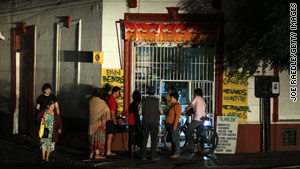
Santiago, Chile (CNN) -- Much of Chile was in the dark Sunday after a blackout knocked out power to 90 percent of the country, CNN's sister network in the country reported.
The blackout was caused by an overheated transformer in the Bio Bio area, the country's minister of energy, Ricardo Rainien, told CNN Chile. Rainien said crews were slowly restoring power, and he expected electricity to be fully restored by midnight Sunday.
Subway service was also affected, CNN Chile said, but all passengers had been evacuated from stopped trains as of Sunday night.
Government officials were asking residents to stay calm and remain in their houses until power is restored.
The blackout comes two weeks after a massive 8.8-magnitude earthquake struck the country, killing more than 500 people. Aftershocks as high as magnitude 7.2 continue to disrupt recovery efforts.
Rainien said that another blackout is possible because of the weakened electrical system following the quake.

Beckham injury mars late Milan victory


(CNN) -- David Beckham suffered an Achilles tendon injury before Clarence Seedorf scored in the final minute to give AC Milan a 1-0 win over Chievo on Sunday, a result that moved them to within a point of leaders Inter at the top of Serie A.
Veteran England midfielder Beckham hobbled off the pitch in tears, reaching down to nurse his left heel, with TV network Sky Sports Italia reporting that he had suffered a suspected ruptured Achilles tendon injury.
If that proves to be the prognosis, it would leave Beckham's hopes of appearing for England at this summer's World Cup finals in tatters.
One sports physician has said Beckham has no chance of playing in the World Cup in South Africa, according to the Press Association.
"It's remotely possible he may be running in three months," said Dr Tom Crisp. "The chances of him being fit to play for England are non-existent."
Beckham's injury soured Milan's eventual win, achieved with just 10 men as all three substitutes had already been deployed before the former Manchester United midfielder was forced to limp off.
One of those substitutes, Seedorf, was to score the only goal of the game, firing home a superb long-distance strike.
"This was an important victory, but this injury prevents us from really enjoying it. It's an important injury and we need to be able to judge how serious it is," Milan coach Leonardo told Sky Sports Italia.

The win means Milan move to within a single point of leaders and city rivals Inter at the top of the table.
Elsewhere, Juventus managed to waste a three-goal advantage, with all their goals coming in the opening 10 minutes, to draw 3-3 at home to Siena.
Alessandro del Piero netted two of Juve's goals, but Abdel Kader Ghezzal also hit a double for the visitors to leave Juventus coach Alberto Zaccheroni stunned.

Roma remain in third position, six points behind Inter, after they were also held to a 3-3 draw, this time at struggling Livorno -- for whom Cristiano Lucarelli scored a hat-trick.
A dramatic weekend in Serie A began on Friday night when leaders Inter had Sulley Muntari sent off in a shock 3-1 defeat at Catania.

 Thanks cnn and you can see detail in http://www.cnn.com/2010/SPORT/football/03/14/football.milan.chievo.juventus/index.html?hpt=Sbin

Tropical Cyclone Tomas slams Fiji


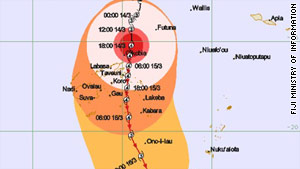
(CNN) -- Tropical Cyclone Tomas battered Fiji's northern islands on Monday evening with gusts of up to 275 km/h (170 mph) and heavy rain, but weather officials had not received immediate reports of damage.
The Category 4 storm is the second-most destructive on a five-point scale. As it heads southeast, it is expected to sideswipe the main island, Viti Levu. The South Pacific nation's capital, Suva, is on that island.
"The closest it will come is 200 km (124 miles) to the east of Suva," said Alipate Waqaicelua, forecaster for the Nadi Tropical Cyclone Center.
iReport: Are you there? Share photos, video
Still, the storm inundated the capital with heavy rain and strong winds. Authorities imposed a nighttime curfew. Schools have been ordered closed till Thursday, and banks were shuttered till Tuesday, said resident Moses Waqavonovono.
"Squatter houses have been blown away in the gusting winds," he said. "The stronger structures will take a hard hitting tomorrow." 

Bus plunges off bridge in India, kills 26

New Delhi, India (CNN) -- A bus plummeted 70 feet into a dry riverbed in northwestern India on Monday, killing at least 26 passengers and injuring 34 others, police said.
The wreck occurred before dawn in the Swai Madhopur district of Rajasthan state when the bus hit a vehicle parked on a bridge and smashed through the span's railing, police superintendent Vikas Kumar said.
Most of the passengers were students, ages 20 to 25, he said.
The injured passengers have been hospitalized, Kumar said.

Car bomb kills at least 7 in Iraq


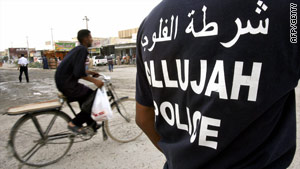
Baghdad, Iraq (CNN) -- A parked car bomb detonated Monday on a busy street in central Iraq, killing at least seven people and injuring 13 others, police said.
The morning explosion happened near the municipality building in Falluja, about 37 miles (60 km) west of Baghdad. The bomb exploded near a group of construction day laborers.
Falluja is a predominately Sunni town in Anbar province. This was the first serious attack since last week's Iraqi parliamentary elections.
On Sunday, Prime Minister Nuri al-Maliki's alliance took the lead after partial preliminary election results showed his group ahead in seven provinces, according to the electoral commission.
On Monday, at least 60 percent of votes in all provinces will be tallied and partial results will be announced, elections officials said.
Al-Maliki's State of Law alliance led in six southern Iraqi provinces and in Baghdad, where the most parliamentary seats -- 68 out of 325 -- are up for grabs, according to the electoral commission. 

3 people associated with U.S. consulate killed in Mexico


(CNN) -- Three people connected to the U.S. consulate in Ciudad Juarez, Mexico, were killed in two drive-by shootings, a senior White House official told CNN Sunday.
Two of the victims were an American employee at the consulate and her U.S. citizen husband. Their 1-year-old child, who was in a vehicle with the couple at the time of the shooting, survived the incident, according to the El Paso County Sheriff's Office.
The American couple, identified by Mexican authorities only as a woman about 25 years old and a man around 30, were found dead inside a white Toyota RAV4 with Texas license plates, according to the Chihuahua state attorney general's office.
The woman was shot in the neck and left arm, while the man had a bullet wound near his right eye, officials said.
"We know that the U.S. citizens were targeted," Juarez Mayor Jose Reyes Ferriz told CNN, saying a police officer witnessed a car shooting at the Americans' car. "We know they were chasing them. We know they wanted to kill them."
The Americans were identified as Arthur Redelfs, 34, and Leslie Enriquez by the El Paso County Sheriff's Office, where Redelfs worked as a detention officer.
Redelfs was a 10-year veteran of the department, according to Jesse Tovar, a spokesman for the sheriff's office.
"On behalf of the men and women of the Sheriff's Office, I would like to extend our deepest sympathy and condolences to the family during this difficult time," said Sheriff Richard Wiles. "Our thoughts and prayers are with them."
Authorities retrieved only one shell casing, from a 9 mm weapon.

About 10 minutes before authorities received the call, they were alerted to a body inside a 2003 Honda Pilot. Inside was the husband of the Mexican employee, identified as Jorge Alberto Salcido Ceniceros, 37. Reyes said the victim was a state police officer who was married to a Mexican employee at the U.S. consulate.
Two children, 4 and 7, were injured in that shooting and transported to the hospital, the attorney general's office said.
Police recovered two shells at that scene from an assault rifle, authorities said.
"The president is deeply saddened and outraged by the news of the brutal murders of three people associated with the United States Consulate General in Ciudad Juarez," National Security Council Spokesman Mike Hammer said in the statement Sunday. "He extends his condolences to the families and condemns these attacks on consular and diplomatic personnel serving at our foreign missions. In concert with Mexican authorities, we will work tirelessly to bring their killers to justice."
In response, the U.S. State Department authorized the temporary relocation of employees' families working in border-area consulates.
"These appalling assaults on members of our own State Department family are, sadly, part of a growing tragedy besetting many communities in Mexico," Secretary of State Hillary Clinton said in a statement Sunday night. "They underscore the imperative of our continued commitment to work closely with the Government of (Mexican) President (Felipe) Calderón to cripple the influence of trafficking organizations at work in Mexico."
The families of employees at U.S. consulates in Tijuana, Nogales, Ciudad Juarez, Nuevo Laredo, Monterrey and Matamoros, are allowed to leave for a period of 30 days "in response to an increase in violence along the Mexican side of its border with the U.S.," State Department spokesman Fred Lash told CNN.
After 30 days, the authorization can be renewed, depending on a review, Lash said, adding that this was not a mandatory evacuation.
The announcement was part of a warning to American citizens regarding travel to Mexico.
The warning urges U.S. citizens to delay nonessential travel to parts of the states of Durango, Coahuila and Chihuahua, where Juarez is located, because of recent violent attacks. U.S. government employees are restricted from traveling to all or parts of these three states.
The attacks include the kidnapping and killing of two resident U.S. citizens in Chihuahua, the warning states.
"Some recent confrontations between Mexican authorities and drug cartel members have resembled small-unit combat, with cartels employing automatic weapons and grenades," the warning says. "During some of these incidents, U.S. citizens have been trapped and temporarily prevented from leaving the area."
The mayor said the shootings highlight a problem shared by both countries along their border.
"It is not just a Mexican problem -- it's is a U.S.-Mexico problem," Reyes said. "I'm very glad that the U.S. has taken that position."
He said he supported the State Department's authorization to consular families and that "it is important they feel safe."
Mexico on Sunday said that its government was committed to protecting all people, citizens and visitors alike, diplomats or not.
"The Mexican government deeply laments the killings of three people linked to the U.S. Consulate in Ciudad Juarez," Mexico's foreign ministry said in a statement. "The Mexican authorities are working with determination to clear up the facts surrounding the crime scene and put those responsible before the law."
Juarez is one of the front lines in Mexico's war against the drug cartels that operate in its territory. More than 2,600 people were killed in Juarez in 2009.
Juarez, across from El Paso, Texas, has become a focal point of Mexican President Felipe Calderon's anti-drug efforts after the January 31 killings of 15 people, most of whom were students with no ties to organized crime. The incident sparked outrage across Mexico.
In the western state of Guerrero, at least 25 people were killed in a series of violent acts on Saturday, state officials said.
The bodies of 14 people, including nine civilians and five police officers, were found in various parts of the resort city of Acapulco, the official Notimex news agency reported, citing Guerrero Public Security Secretary Juan Heriberto Salinas.
In the small city of Ajuchitlan del Progreso, 10 civilians and one soldier were killed in two shootouts that started when federal officials tried to carry out search warrants on two locations, Salinas said.
Police in the state were on a heightened security alert, he said.
The government has not released official figures, but national media say 7,600 Mexicans lost their lives in the war on drugs in 2009. Calderon said last year that 6,500 Mexicans died in drug violence in 2008.
Thanks cnn and you can see detail in http://www.cnn.com/2010/WORLD/americas/03/14/mexico.violence/index.html?hpt=Sbin

Saturday, March 13, 2010

32 asylum seekers rescued off Australian coast

(CNN) -- Australia rescued 32 people seeking asylum this week after spotting them floating on boats off the country's northwest coast.
The asylum seekers were spotted on two different boats Thursday sailing near the Tiwi Islands, the Australian Ministry of Home Affairs said. The group said they wanted to come to Australia.
The two separate rescues highlights the problem of smugglers taking asylum seekers on these dangerous trips, Australian officials said.
"People smuggling is a deplorable act with organizers putting innocent people's lives at risk. The Australian government is pleased that the group is safe," said Brendan O' Connor, minister for home affairs.
Australian officials did not say what country the asylum seekers were from. In the past, Australian officials have strongly criticized human traffickers.
Last year Prime Minister Kevin Rudd attacked smugglers after an explosion aboard a boat carrying Afghan refugees killed three people and injured more than 40 others near Ashmore.
"People smugglers are engaged in the world's most evil trade and they should all rot in jail because they represent the absolute scum of the earth," Rudd said at the time.

 Thanks cnn and you can see detail in http://www.cnn.com/2010/WORLD/asiapcf/03/12/australia.asylum.seekers.rescue/index.html?hpt=Sbin

Attorney: Belgian terror suspect says spouse met bin Laden in 2008


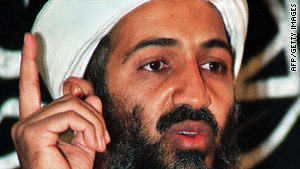
(CNN) -- A Belgian woman on trial in Belgium for involvement in terrorism says her husband -- himself wanted on terror charges -- met al Qaeda leader Osama bin Laden in the summer of 2008.
Christophe Marchand, a defense attorney at the trial, told CNN that Malika el Aroud made the claim during testimony Thursday. Marchand said el Aroud was questioned about an e-mail exchange in summer 2008 she had with an alleged jihadist now in French custody.
In that exchange, el Aroud said that her husband, Moez Garsallaoui, had sent her an e-mail in which he said he met with "the chief" in a mountainous region.
The judge at her trial asked whether she meant bin Laden -- to which el Aroud replied, "Yes." Marchand said el Aroud gave no other details about the reported meeting, and the e-mail was not produced in court.
Belgian intelligence sources said Garsallaoui, a Tunisian citizen, is believed to be at large somewhere in the Afghanistan-Pakistan border region. Garsallaoui is alleged to have acted in tandem with his wife to recruit six individuals from Belgium and France to make the journey to al Qaeda's camps in Pakistan's Waziristan. Several of them are now on trial with Malika el Aroud.
There have been no confirmed sightings of bin Laden since he escaped from Tora Bora in Afghanistan in December 2001. While the working assumption of Western intelligence agencies is that he is somewhere in the Afghanistan-Pakistan border region, it is thought few al Qaeda members know his location.
One alleged member of the Belgian-French group that traveled to the region, Walid Othmani, reportedly told French interrogators that no recruits were allowed to meet al Qaeda's leader because of security concerns.
In June 2008, around the time el Aroud said he met bin Laden, Garsallaoui wrote to his wife, claiming to have killed several Americans in Afghanistan, according to Belgian legal documents. U.S. counterintelligence intercepted that e-mail.
El Aroud's first husband was Abdessattar Dahmane, also a Tunisian citizen. Two days before the September 11, 2001, attacks, he assassinated Ahmad Shah Massoud, the head of the anti-Taliban Northern Alliance, in a suicide bombing that bin Laden ordered.

 Thanks cnn and you can see detail in http://www.cnn.com/2010/WORLD/europe/03/12/belgium.osama.visit/index.html?hpt=Sbin

Clinton: Israeli settlement announcement insulting

Washington (CNN) -- Secretary of State Hillary Clinton said Friday that Israel's announcement of new settlement construction in disputed territory in East Jerusalem was "insulting" to the United States.
The Israeli announcement came during Vice President Joe Biden's visit this week to Israel. It complicated U.S. efforts to set up so-called proximity talks between the Israelis and Palestinians, the latest attempt to nudge the two sides back toward talking directly.
Clinton said the United States' relationship with Israel is not at risk: "Our relationship is durable. It's strong. It's rooted in common values."
"But we have to make clear to our Israeli friends and partners that the two-state solution -- which we support, which the prime minister himself says he supports -- requires confidence-building measures on both sides," Clinton told CNN's Jill Dougherty. "And the announcement of the settlements the very day that the vice president was there was insulting."
The construction, announced Tuesday, will be in the Ramat Shlomo neighborhood, in disputed territory in East Jerusalem. The Israeli Interior Ministry denies that the territory is in East Jerusalem.
Biden arrived in Israel on Monday, meeting first with Israeli President Shimon Peres at his official residence in Jerusalem and then with Prime Minister Benjamin Netanyahu. Biden emphasized the close relationship between the United States and Israel as he met with Israeli leaders Tuesday, a visit that also touched on relations with the Palestinians and Iran.
However, later Tuesday, after getting word of the settlement announcement, Biden said the United States condemned Israel's decision to build 1,600 housing units in the Jerusalem neighborhood, calling it "a step that undermines the trust we need right now."
The Israeli Interior Ministry said the construction plan was approved by a district committee, and the public can express objections to it over the next 60 days.
"I mean, it was just really a very unfortunate and difficult moment for everyone -- the United States, our vice president who had gone to reassert our strong support for Israeli security -- and I regret deeply that that occurred and made that known," Clinton said Friday.
She added that she has no reason to believe that Netanyahu knew about the announcement during Biden's visit but added, "He is the prime minister. Like the president or secretary of state ... ultimately, you are responsible."
The controversy over Israel's announcement came just a day after the Obama administration's special envoy for Middle East peace announced that Israeli and Palestinian leaders had accepted indirect talks.
George Mitchell said Monday that the two sides, with him acting as intermediary, had begun to discuss the "structure and scope" of the talks.
"I will return to the region next week to continue our discussions," Mitchell said. "As we've said many times, we hope that these will lead to direct negotiations as soon as possible."
Negotiations between Palestinians and Israelis have been stalled for more than a year, despite the Obama administration's attempt to move toward a resolution of the decades-old Israeli-Palestinian conflict.
Under current agreements between Israel and the Palestinian Authority, Israel maintains full control over the West Bank and its borders while the Palestinian government oversees administration of major population centers.
Speaking at a Christians United for Israel convention in Jerusalem on Monday, Netanyahu said he welcomes "the initiation of the peace process between us and the Palestinians."
"We have been calling to resume the talks without prior conditions for almost a year now," he said. "I hope that the proximity talks will soon lead to direct talks."

Japan arrests anti-whaling activist

 Tokyo, Japan (CNN) -- Japanese authorities arrested an activist from New Zealand on Friday for illegal trespassing after he boarded a whaling ship last month in waters off the Antarctic.
Peter James Bethune, 44, is accused of jumping from a Jet Ski onto the Shonan Maru 2, the security ship of a Japanese whaling fleet, after the Ady Gil boat, of which Bethune was captain, sank.
Bethune belongs to the activist group Sea Shepherd Conservation Society. The group said the New Zealander was attempting to make a citizen's arrest of the Shonan Maru 2 skipper for the collision that sank the Ady Gil, a futuristic vessel used to intercept and block harpoon ships, in January.
Hirotaka Akamatsu, Japan's minister of agriculture, forestry and fisheries, said Japan would take a firm stance against Bethune. He said Sea Shepherd's acts were not acceptable.
"Their violent acts are escalating," Akamatsu said.
Bethune was taken into custody a month ago aboard the Shonan Maru 2, which arrived from Antarctic waters -- where Japan conducts its annual whale hunt -- back to Japan on Friday. He was formally arrested then.

Bethune has legal representation in Japan, said Sea Shepherd spokeswoman Traci Walter.
A spokesperson for the New Zealand Ministry of Foreign Affairs and Trade said the government was providing consular assistance to Bethune on his arrival in Japan.
The Bethune case highlights an ongoing feud between Japanese whaling fleets and conservation agencies, especially the hardline Sea Shepherd.
Activists have used butyric acid -- found in rancid butter and vomit -- and fired paint guns at Japanese whaling ships, which in turn have repelled protesters with water cannons.
Japan's Institute of Cetacean Research, a branch of the fisheries ministry that deals with whaling, accuses Sea Shepherd of jeopardizing the safety of fleets that are conducting research legally.
Sea Shepherd uses its boats to interfere with whaling and fishing boats, and its efforts have included ramming a Portuguese whaler in 1979.
Two years ago, Sea Shepherd activists boarded a Japanese ship and handcuffed themselves to the vessel with plastic ties.
Japanese authorities had called the Shonan Maru 2 incident the latest "publicity stunt" by Sea Shepherd activists.
Sea Shepherd has accused the Shonan Maru 2 of destroying the Ady Gil during the skirmish in the Southern Ocean -- a term used to describe parts of the Indian, Pacific and Atlantic oceans that surround Antarctica.
However, Japanese authorities deny their ship intentionally hit the high-tech catamaran and have said the activists were harassing their whaling fleet.
In the early 1980s, the International Whaling Commission determined that there should be a moratorium on commercial whale hunting. But whaling is allowed under international law when done for scientific reasons, which Japan cites as the legal basis for its hunts.
The country's annual hunt kills up to 1,000 whales a year.

Beheaded Vikings found at Olympic site

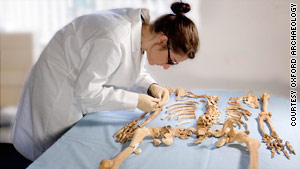
London, England (CNN) -- They were 51 young men who met a grisly death far from home, their heads chopped off and their bodies thrown into a mass grave.
Their resting place was unknown until last year, when workmen excavating for a road near the London 2012 Olympic sailing venue in Weymouth, England, unearthed the grave. But questions remained about who the men were, how long they had been there and why they had been decapitated.
On Friday, officials revealed that analysis of the men's teeth shows they were Vikings, executed with sharp blows to the head around a thousand years ago. They were killed during the Dark Ages, when Vikings frequently invaded the region.
"To find out that the young men executed were Vikings is a thrilling development," said David Score, project manager for Oxford Archaeology, which excavated the remains. "Any mass grave is a relatively rare find, but to find one on this scale, from this period of history, is extremely unusual and presents an incredible opportunity to learn more about what is happening in Dorset at this time."
Radiocarbon dating had already placed the remains between A.D. 890 and 1030, before the Norman conquest of Anglo-Saxon England.

On Friday, officials revealed that analysis of the men's teeth shows they were Vikings, executed with sharp blows to the head around a thousand years ago. They were killed during the Dark Ages, when Vikings frequently invaded the region.
"To find out that the young men executed were Vikings is a thrilling development," said David Score, project manager for Oxford Archaeology, which excavated the remains. "Any mass grave is a relatively rare find, but to find one on this scale, from this period of history, is extremely unusual and presents an incredible opportunity to learn more about what is happening in Dorset at this time."
Radiocarbon dating had already placed the remains between A.D. 890 and 1030, before the Norman conquest of Anglo-Saxon England.

Scientists from the British Geological Survey then went further and analyzed the men's teeth to find out exactly where they were from. Isotope analysis of teeth can reveal clues about a person's drinking water, and in turn the climate they came from, said Jane Evans, an isotope geochemist at the survey.
"What we found was all of these guys came from a climate that had to be colder than Britain ... probably Sweden and Norway," Evans said by phone Friday. "One guy had such a signature of such a cold climate that he probably came from above the Arctic Circle."
The isotopes also show the men had eaten a high-protein diet, comparable to known sites in Sweden. It means the men were probably Scandinavian Vikings who were executed by Anglo-Saxons.
Evans and her colleagues at the British Geological Survey's NERC Isotope Geosciences Laboratory in Nottingham, England, analyzed 10 of the skeletons over the course of six weeks.

"These results are fantastic," Evans said. "This is the best example we have ever seen of a group of individuals that clearly have their origins outside Britain."
Many of the executed men suffered multiple wounds, inflicted by a sharp-bladed weapon, to the skull, jaw and upper spine, all thought to relate to the process of decapitation, the Dorset County Council said.
Some men show evidence of other wounds, including a cut to the pelvis, blows to the chest and stomach, and defensive injuries to the hands, the council said.
The bones still appear cleanly sliced, indicating the men suffered a "sword-based execution," Evans said.
There are also two examples of healed fractures that are unlikely to have been medically treated. In one case, the skeleton's right leg is 5 centimeters, or about 2 inches, shorter than the left, which would have given the person a pronounced limp, the council said.
The burial site was found during work for the Weymouth Relief Road, meant to ease traffic congestion on the highway to Weymouth, on England's southern coast. Weymouth Bay and nearby Portland Harbor will host the Olympic and Paralympic sailing events during the 2012 London Olympics.
The leader of the Dorset County Council, Angus Campbell, said the construction of the road had already revealed prehistoric and Iron Age finds.
"But we never would have dreamed of finding a Viking war grave," Campbell said in a statement. "The burial pit took us all by surprise and its story gets more fascinating as the analysis goes on."
Researchers are hoping to find further evidence about the men's lifestyles, activity, health and diet, the council said.
Thanks cnn and you can see detail in http://www.cnn.com/2010/TECH/science/03/12/viking.olympics/index.html?hpt=Sbin

How helping hands could hurt Haiti

(CNN) -- The same hands that are helping Haiti recover from a massive earthquake could cripple its long-term recovery.
That's the concern voiced by some Haitian scholars, natives and relief workers.
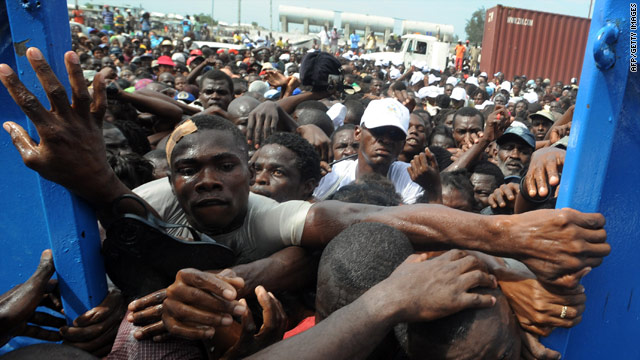
The world has rallied to Haiti's side since the January 12 earthquake killed at least 217,000 people and displaced at least a million in the impoverished island nation.
Yet the same groups that have lined up to help Haitians the past two months -- foreign governments, relief groups and companies pledging to rebuild -- could hobble Haiti's long-term survival, some say.
Ronald Agenor, a Haitian-American, says he's grateful for the world's assistance. But he doesn't want the earthquake to wipe out one of his native country's most precious assets: its independence.
"We're not a country anymore," said Agenor, a former top-ranked professional tennis player. "It doesn't seem like we have a government. We're a place where people go to give money."
How aid can hinder Haiti's government
Much of Haiti's national identity is shaped around its unique history. Haitians are the descendants of the only slaves who revolted against their masters in the 19th century.
Haiti, though, has struggled since it broke away from its colonial rulers, the French. Even before the earthquake, unemployment hovered around 50 percent, and more than half of all Haitians live on a dollar a day. Ongoing political instability adds to Haiti's misery.
Western nations and relief groups have stepped in over the years to help. But some of that help has backfired, says Alex Dupuy, a native of Haiti and a professor of sociology at Wesleyan University in Connecticut.
"Haiti has been transformed over the years into an aid-dependent country," Dupuy said. "Much of the aid has further weakened the ability of the state to deliver."
In Haiti, the government doesn't provide basic services such as sanitation, electricity and drinking water, Dupuy says. Much of that is provided by non-governmental organizations, or NGOs, like relief groups, he says.
"It becomes a vicious cycle," Dupuy said. "The state is never forced to face up to its responsibilities."
Educated Haitians could stay and help their country, but many prefer to move elsewhere for more comfortable living, Dupuy says.
"There are more Haitian doctors practicing medicine in Montreal than in Haiti," Dupuy said.
Full earthquake coverage
Those educated Haitians who do stay are often siphoned off into working for the non-governmental organizations stationed there, says J. Phil Thompson, an urban studies professor at the Massachusetts Institute of Technology who has traveled to disaster zones around the world to help communities recover.
Thompson says there are about 10,000 NGOs in Haiti.
"Haitians often don't want to work for the government, because the salaries can't compete with the donations various intermediaries can pay," Thompson said.
Profiting from Haiti's misery
Helping hands have hurt Haiti in the past, some Haitians say. Powerful outsiders took advantage of Haiti's weakened government for profit.
Dupuy says that in the early 1970s, Haiti was self-sufficient in its rice production. Today, it is the fourth largest importer of rice from American farmers who are subsidized by the U.S. government.
The change came about because much of the foreign aid to Haiti had strings attached. Haiti had to remove its tariffs and open its economy to foreign imports, he says.
"All of which had devastating impacts on Haitian agriculture," Dupuy said. "Haiti has nothing to show for it. Now it imports 25 percent of the food it consumes."
Haiti's impoverished condition also provides opportunity for companies that flock to the country.
"It's being used as a haven for cheap labor in the textiles and garment industries," Dupuy says. "Those industries are going to Haiti because there is an abundance of the cheapest labor in the Western hemisphere."
Even those companies that promise to help rebuild Haiti must be viewed with suspicion, one scholar says.
Haiti's recovery could be hampered by unscrupulous outsiders and opportunistic Haitians who may seize land for themselves by passing their efforts off as "helping the recovery," Thompson said.
After Hurricane Katrina wiped out the Lower Ninth Ward in New Orleans, Louisiana, a group of developers proposed turning the area into a golf course, Thompson says. After the 2004 Asian tsunami, developers proposed building luxury hotels on the fishing communities that had just been wiped out, he added.
The same pattern could repeat itself in Port-au-Prince, the capital, to "redevelop" Haiti, Thompson says.
"Everywhere I've worked, where there's been a disaster, there's been land grabs by the elite," Thompson said.
Haitians say how their country can recover
Haitians can come out of this disaster stronger if they take more control of their destiny, Thompson says.
Thompson suggests that Haitians create a social investment fund, which would be used to funnel money that expatriates send to their homeland into investments in renewable energy, education and housing.
It's been estimated that up to 36 percent of Haiti's gross national product comes from remittances, or money Haitians receive from other Haitians abroad.
"Because Haitians are investing in Haiti, they are going to make sure no one is ripped off," Thompson said of the investment fund.
Agenor, the Haitian-American tennis player, recommends an even more subtle change for improving his country's prospects: teach more English to Haitian youth.
Creole and French are the primary languages in Haiti. But the best employment opportunities for Haitians rest about an hour's flight away in the U.S., where English is the main language, Agenor says.
"We have a French culture, but we're so close to America," said Agenor, who now lives in Los Angeles, California. "When Haitians go to America, they don't speak English. They can't go to college. When other English-speaking islanders go to America, 80 percent of the job is done."
Relief groups can help Haitians in the short term by not only providing food, shelter and water but by hiring Haitian workers in reconstruction projects and soliciting their advice, one relief expert says.
"There's nothing worse than a bunch of foreigners coming in to fix everything," said David Humphries, a spokesman for CHF International, a humanitarian organization that is in Haiti. "Self-esteem and buy-in are very important for any community. They need to say, 'This is our building, our hospital.' "
iReport: Haiti's missing and found
Local input can also avoid wasting precious resources, Humphries says.
"You can build a hospital, but if there's no functional road to it, it's a white elephant," Humphries said. "People will despise it. Go in the community, get their input and employ them."
Despite the challenges ahead, some Haitians remain optimistic. News accounts of the earthquake's aftermath are filled with stories about the resilience of Haitian people.
Maggie Boyer, a Haitian native who is communications director for World Vision, an international Christian humanitarian agency, says the street vendors and the colorful Tap-Tap taxicabs have returned to the streets of Port-au-Prince.
"Given our history as the first black republic," Boyer said, "this has left us with the sense that we are good, we can win, and we can go forward."

Friday, March 12, 2010

Three strong earthquakes strike Chile in quick succession

Santiago, Chile (CNN) -- Three strong earthquakes rocked Chile on Thursday, causing significant damage in at least one city, the country's newly inaugurated president said Thursday.
A 6.9-magnitude earthquake hit at 11:39 a.m. local time (9:39 a.m. ET), followed by a 6.7-magnitude quake 16 minutes later, the U.S. Geological Survey reported. A third, measured at magnitude 6.0, came 27 minutes later.
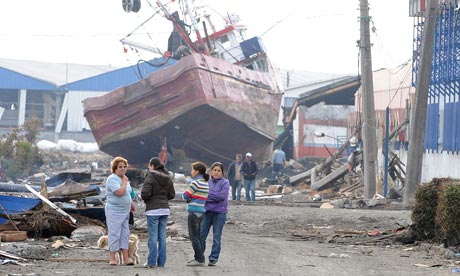
They were the strongest aftershocks to rattle Chile since a February 27 earthquake on the country's west coast that toppled buildings and spawned a tsunami, killing several hundred people.
Thursday's quakes shook the ground near Libertador General Bernardo O'Higgins near the coast just as Chile prepared to inaugurate a new president, Sebastian Pinera.
The central Chilean city of Rancagua was affected, Pinera said.
"There is significant damage in Rancagua," the new president said. "We're going to send the necessary armed forces to guarantee citizens' safety."
Rancagua Mayor Eduardo Soto said that no fatalities were immediately reported and that the biggest worry was damage to homes, CNN Chile reported.
After his inauguration Thursday, Pinera visited Rancagua, where he confirmed there were no initial reports of fatalities.
He said that no curfew would be imposed for now and reiterated his call for calm. A priority is for the school year to start as scheduled next week, he said.
He also said Thursday afternoon that he would declare the area a catastrophe zone.
The country's national emergency authorities also put in place a tsunami alert for the coastal area near where the earthquakes hit, and authorities ordered evacuations of some coastal areas.
"I don't want to alarm anyone, [the alert] is solely precautionary, but we have to take precautions when there are human lives at risk," Pinera said.
The epicenter of Thursday's first quake was about 95 miles (152 km) south-southwest of the capital, Santiago, and about 90 miles (145 km) away from Valparaiso, where Pinera was to be inaugurated. Television footage showed the inauguration proceeding without a hitch.
A second earthquake -- with an initial magnitude of 6.9 -- struck moments later. It was about 89 miles (143 km) southwest of Santiago, the USGS said. The third was about 86 miles (138 km) southwest of Santiago.
Rolando Santos, senior vice president and general manager of CNN Chile, said he and his colleagues felt one of the quakes.
"I can tell you within our newsroom in Santiago, which is state of the art in terms of seismic construction, it shook for more than 45 seconds," he said.
He said that he told staffers to get under desks and that three people burst into tears. In the last two days, people had kind of gotten used to aftershocks, but "there was no question this one got everyone's attention," he said.
Are you there? Send pictures
Pinera, a conservative billionaire businessman, became the Chilean president about 12:15 p.m. local time, roughly 20 minutes after the second quake.
The Pacific Tsunami Warning Center said in a statement that "a destructive Pacific-wide tsunami is not expected" as a result of the quakes, and that there is no tsunami threat to Hawaii.
However, the center also said that "earthquakes of this size sometimes generate local tsunamis that can be destructive along coasts located within" about 62 miles (100 km) of the epicenter.
Hundreds of people were killed when the magnitude-8.8 earthquake struck Chile's west coast February 27. That quake also triggered a tsunami that toppled buildings, especially in the coastal Maule region.
How to help: Impact Your World
Authorities this week released the names of 279 people whose bodies had been identified in the quake, but officials said the new tally does not include hundreds of unidentified victims.
The February 27 earthquake was violent enough to move the Chilean city of Concepcion at least 10 feet to the west and Santiago about 11 inches to the west-southwest, researchers said.

Early Iraq election results put prime minister's group in lead


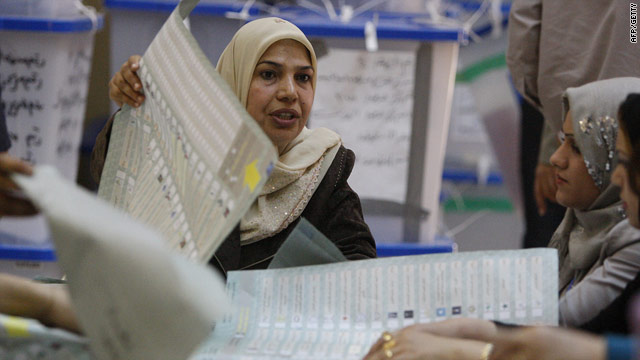
Baghdad, Iraq (CNN) -- The first results from Iraq's parliamentary elections were released Thursday, five days after millions of Iraqis went to the polls in defiance of the threat of violence.
Two of Iraq's 18 provinces announced early results, which put the group led by Prime Minister Nuri al-Maliki in the lead.
The predominantly Shiite Iraqi National Alliance -- which includes the secular politician Ahmed Chalabi as well as followers of radical cleric Muqtada al-Sadr -- is in second, followed by Al-Iraqia, a secular party led by former interim Prime Minister Ayad Allawi.
But the results are preliminary -- only about a third of the votes in each of the two provinces have been counted, and the other 16 provinces have not announced any results yet.
Share your thoughts on the election results so far
It may be some time before a clear picture emerges of who will lead Iraq. Final results, which need to be certified by Iraq's Supreme Federal Court, are expected to be released at the end of the month.
If no party wins a majority of seats, then coalition haggling will begin. Millions of Iraqis defied the threat of violence Sunday to cast ballots in the parliamentary elections.
Nearly two out of three eligible voters turned out. Some 38 people were killed in attacks on voting day. About 6,200 candidates from more than 80 political entities are vying for 325 seats in the Council of Representatives, as Iraq's parliament is called.
The political coalition that ends up with the most number of seats in parliament will put forward a candidate for prime minister.

Thursday, March 11, 2010

Nigerian violence fed by ethnic, economic issues, ex-president says

(CNN) -- Former Nigerian President Olusegun Obasanjo insisted Wednesday that this week's explosion of violence that claimed at least 200 lives is not driven by religious tensions between Christians and Muslims -- but by ethnic, social, and economic problems.
In Sunday's violence near the central city of Jos, Christian villagers said a mob armed with guns, knives and machetes killed and burned at will, leaving a trail of death and destruction. The attack came in the same area that 150 Muslims were killed in January.
In an interview with CNN's Christiane Amanpour, Obasanjo said, "If you have one group or a community that has land that's been encroached upon by another community or even by itinerant cattle farmers, then the people who lay claim to the land will fight back."
"If there are job opportunities in an area, and persons believe they are indigenous to that area, and (are) not getting enough out of the jobs that are available, they will fight those who are getting the jobs," Obasanjo said.
Obasanjo said he's convinced the conflict in the oil-rich nation does not have religious roots, because Nigerian religious leaders have come together and deliberated on the problems in Jos, which lies on a faith-based fault-line between Muslim-dominated northern Nigeria and the mainly Christian south.


The former president also said it will be very dangerous if the acting president of Nigeria, Goodluck Jonathan, fails to implement reforms quickly because that country -- Africa's most populous -- is full of expectations for change.
Thousands of Nigerians Wednesday protested in the Nigerian capital, Abuja, demanding urgent action from the government on a host of issues ranging from corruption to unemployment.
CNN's Christiane Purefoy, reporting from the scene, said there was a lot of tension between police and the protesters, who believe that local governors are trying to get away with as much as they can because there's no one in charge at the top.
Acting President Jonathan continues to hold the reins of power, even though ailing President Umaru Yar'Adua has returned to Nigeria after three months treatment for an unspecified medical condition in Saudi Arabia.
Purefoy reported that Jonathan hardly ever makes any public appearances, and seems to be acting president in name only, without exercising real power.
Obasanjo said the whole episode with Yar'Adua is unusual. "I think ... the way it was handled by his handlers and the way it's been couched in secrecy and shrouded in mystery is strange. Somebody said it can only happen in 'wonderland' Nigeria."
Nigerian Nobel Prize winner Wole Soyinka told Amanpour the Nigerian people are demanding a sovereign national conference to empower the right people to restructure and reform the country.
He said next year's general election will be crucial to the future of the nation. "Right now we're running a constitution that has been imposed on the people themselves," he added.
Soyinka said the political system in Nigeria has been handed down first by the colonial past, and then by what he called "the internal colonial past," which is the military.
Amanpour also spoke with another Nobel Prize laureate on the program, Archbishop Desmond Tutu of South Africa, who has always preached reconciliation over the urge for revenge.
Tutu has written a new book "Made for Goodness" with his daughter, the Rev. Mpho Tutu. The book says that people are inherently good and there is inherent goodness on the earth.
"All of history has demonstrated the truth that evil people, evil systems, don't last forever. They bite the dust," Archbishop Tutu said.
"The fact of the matter is that evil is really an aberration. After God creates, God says, it is not just good, it's very good... and God rubs both hands and says 'ha, ha.'"
Archbishop Tutu was chairman of the Truth and Reconciliation Commission in South Africa that tried to heal the wounds in the country after decades of apartheid.
Reports from Nigeria say lawmakers in the parliament there are proposing their own Truth and Reconciliation Commission, to end the distrust that has fueled the violence in the center of the country.

Mexican mogul Slim edges out Gates as world's richest person


New York (CNN) -- Forbes magazine released its annual list of the world's richest people Wednesday, and for only the second time since 1995, Microsoft founder Bill Gates' name was not at the top.
This year, the title of "World's Richest" went to Mexican telecom mogul Carlos Slim, with a net worth of $53.5 billion.
Slim, whose holding company America Movil contains a sprawling collection of telecom assets, is the first non-American to be declared Forbes' richest person since 1994, when Japanese real estate kingpin Yoshiaki Tsutsumi held that honor. (He has since disappeared from the list entirely).

But Slim's financial edge over Gates is, well, slim, at least by billionaire standards -- just $500 million. A $1 increase in Microsoft shares, the compilers of the Forbes list noted at a press conference Wednesday, could send Gates' net worth ahead of Slim's.

Also, were it not for his extensive philanthropy, Gates would have a net worth in the ballpark of $80 billion, Forbes' Matthew Miller estimated.

Gates is the world's second richest person, with a net worth of $53 billion. Warren Buffett came in third this year, with a net worth of $47 billion.

Billionaires' total net worth rose 50 percent to $3.6 trillion. After sharply contracting the previous year, the total number of billionaires also increased from 793 to 1,011, Forbes' list showed. The number is still lower than the record 1,125 billionaires recorded in 2008.

Not only are there more billionaires than last year, but the ones at the top are even richer than last year. The top 10 billionaires have a combined net worth of $342 billion, up from $254 billion in 2009, Forbes said.

In terms of the international scorecard, the United States still boasts more billionaires than any other country -- 403, or nearly 40 percent of all billionaires. New York, similarly, has more billionaires than any city on the globe.

But America's billionaires have not rebounded from the recession as strongly as other countries' billionaires.

The United States "is not doing as well as the rest of the world in coming back," publisher Steve Forbes said.

As U.S. billionaires' dominance of Forbes' list wanes, Asian countries are seeing their ranks of billionaires swell, especially China. Mainland China has the second-most billionaires after the United States, overtaking Russia for the first time. Taiwan, South Korea, Hong Kong and India also saw significant upticks in their billionaire tallies.

Elsewhere, Turkey's billionaire community expanded notably, jumping to 28 members from 13, while Western Europe, Saudi Arabia and the United Arab Emirates underperformed by comparison.

As in years past, the Forbes list showed a severe gender imbalance in the world's billionaire population

Eighty-nine of the 1,011 billionaires are women. Fourteen of those female billionaires are self-made, including Oprah Winfrey, whose net worth dipped $300 million to $2.4 billion. Half of the world's self-made female billionaires are from China.

For three years running, Facebook founder Mark Zuckerberg, 25, secured the distinction of being the list's youngest billionaire, climbing to the 212th rung with a net worth of $4 billion.

On the opposite end of the age spectrum is Switzerland's 99-year-old Walter Haefner, ranked 287th.

The year's biggest winner was Brazilian minerals magnate Eike Batista, who added $19.5 billion to his net worth in 12 months, enough to catapult him to eighth place on the list, from 61st. Modesty is apparently not one of Batista's many possessions: He has vowed to become the world's richest person.

On the flip side, German heiress Madeleine Schickedanz's bank account had a hideous year. After clocking in as Forbes' 142nd richest person in 2007, she plunged into relative penury and now "claims to be living on several thousand dollars a month," said Forbes senior editor Luisa Kroll.

Death toll rises as violence rocks Somali capital


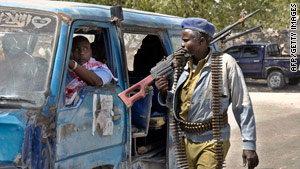
(CNN) -- Heavy fighting flared in the Somali capital Thursday, a day after a battle between government forces and Al-Shabaab rebels left 29 dead and scores injured.
At least 80 people were wounded in the fighting, which started Wednesday morning and continued all day, according to government and medical officials.
Most of it occurred in the north of Mogadishu, where a majority of militants allied with Al-Shabaab are believed to be in control, authorities said.
Three foreign rebels, including Algerian commander Abu Mu'sab Aljaza'iri, were killed in the fighting, government radio reported on its Web site.
"Continuous shelling has shaken the whole city," said Yusuf Mohamed Abukar, a local journalist with Shabelle Radio.
A heavy shell fell in Jungal neighborhood in the northern part of Mogadishu, killing 13 people and wounding another 13, according to Abukar, who witnessed the fighting.
Ali Muse Sheikh, head of a local ambulance, said his group transported at least 65 injured civilians to different hospitals.
The state defense minister claimed victory in Wednesday's fighting and said the Al-Shabaab suffered heavy loses. Government forces have detained Al-Shabaab prisoners, said Yusuf Mohamed Siad Indho ade, the minister.
"We have Al-Shabaab prisoners from yesterday's fighting and most of them are minor children who have been brainwashed by the group,
he added.
Al-Shabaab, the al Qaeda proxy in the country, was declared a terrorist organization by the United States.
It's waging a war against Somalia's government in an effort to implement a stricter form of Islamic law, or sharia.

Somalia has not had a stable government since 1991, and fighting between the rebels and government troops has escalated the humanitarian crisis in the famine-ravaged country.

Parents demand answers from Israel in bulldozer death


Jerusalem (CNN) -- A 23-year-old American activist stands in front of an Israeli bulldozer in Gaza. The bulldozer drives over her, crushing her to death. These are the facts.
Rachel Corrie, along with colleagues from the International Solidarity Movement, was trying to prevent Israel from bulldozing homes in Rafah, close to the Egyptian border. Her activism cost her her life in March 2003.
A colleague said at the time, "Many times the bulldozer came up to us and buried us with dirt, but they always stopped."
Corrie's parents want to know the truth about their daughter's death, whether the killing was intentional and who is accountable.


Craig and Cindy Corrie's civil suit against Israel's defense ministry starts in Haifa, Israel, on Wednesday -- a court date that took years to reach.
"The more we found out, the more likely that the killing was intentional, or at least incredibly reckless," Craig Corrie said. "And, as a former soldier, I was even in charge of bulldozers in Vietnam... You're responsible to know what's in front of that blade, and I believe that they did."
The Israeli military carried out a month-long investigation, which found no Israeli soldier was to blame.
"The armored bulldozer crew involved in the incident did not see Ms. Corrie, who was standing behind the mound of earth, and was unable to see her or hear her voice," the military said.
Corrie's parents are proud of what their daughter did, recalling how important it was to her to help Palestinian families in Gaza.
In an interview shortly before her death, Rachel Corrie, who grew up in Olympia, Washington, said, "There are just countless ways in which these children are suffering. I want to support them."
Her mother, Cindy Corrie, told CNN, "She deserves the attention that she's receiving in this case. Every human being who is assaulted and whose life is taken in this way deserves some accountability, some explanation for why this happened, particularly when it's done by a military and particularly when it's a military supported by me and my tax dollars."
The Corries say they cannot take the bulldozer driver to court, because the Israeli military has refused to identify him for the past seven years. But Craig Corrie doesn't necessarily want to see the driver sent to jail.
"We don't think about the soldiers being the victims, but they are, and we ask a lot of these people. So I'm not full of hatred for this person, but it was a horrendous act to kill my daughter, and I hope he understands that."

Chile quake moves city more than 10 feet


(CNN) -- The magnitude-8.8 earthquake that rocked the west coast of Chile last month was violent enough to move the city of Concepcion at least 10 feet to the west and the capital, Santiago, about 11 inches to the west-southwest, researchers said.
The quake also shifted other parts of South America, as far apart as the Falkland Islands and Fortaleza, Brazil.
The results were reached via global positioning satellite measurements taken before and after the February 27 quake by teams from The Ohio State University, the University of Hawaii, the University of Memphis and the California Institute of Technology, as well as agencies across South America.
NASA scientists have also credited the quake with shifting the Earth's axis enough to create shorter days. The change is negligible, but still worth noting: Each day should be 1.26 microseconds shorter, according to preliminary calculations. A microsecond is one-millionth of a second.
A large quake -- like the one that hit Chile's Maule region -- shifts massive amounts of rock and alters the distribution of mass on the planet.
When that distribution changes, it changes the rate at which the planet rotates. And the rotation rate determines the length of a day.
"Any worldly event that involves the movement of mass affects the Earth's rotation," Benjamin Fong Chao, of NASA's Goddard Space Flight Center in Greenbelt, Maryland, said while explaining the phenomenon in 2005.
Despite the tragedy of the earthquake, which killed hundreds of Chileans, scientists see opportunities to gain valuable information in the aftermath.
"The Maule earthquake will arguably become one of the, if not the most important, great earthquakes yet studied," said Ben Brooks of the School of Ocean and Earth Science and Technology at the University of Hawaii.
"We now have modern, precise instruments to evaluate this event." 

Inside the cat and dog meat market in China

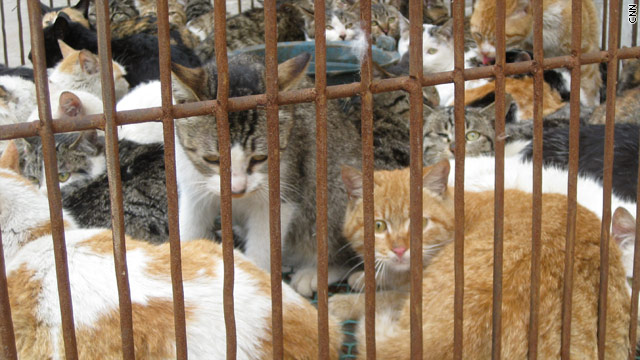
Guangzhou, China (CNN) -- Dogs bark and whine behind high chain-link fences, some of them gnawing the wire so hard they bleed at the mouths while cats packed into crowded cages cower in fear if anyone approaches.
This isn't a pet store -- it's a meat market in Guangzhou, a city in southern China where eating cats and dogs is common practice.
At the Han River Dog Meat Restaurant in central Guangzhou, diners can choose from a long list of menu items, including dog soup, dog steak, dog with tofu and more. In the kitchen, the chef chops up meat for dog hot pot, one of the more popular dishes. Most customers like it spicy.
"Dog meat is good for your health and metabolism," explains Li, the hostess who declined to give her first name. "In the summer it helps you sweat."
But these local restaurants may have to find a new specialty. The Chinese government is considering legislation that would make eating cats and dogs illegal.
Professor Chang Jiwen of the Chinese Academy of the Social Sciences is one of the law's top campaigners. "Cats and dogs are loyal friends to humans," he said. "A ban on eating them would show China has reached a new level of civilization."

Eating dog meat is a long-standing culinary tradition not just in China, but also Korea. Cat meat can be found on the menu in China, Vietnam and even parts of South America.
The Chinese government has signaled a willingness to take the meat off the market. To avoid upsetting international visitors during the Beijing Olympics, officials ordered dog meat off the menus at local markets. Officials in Guangzhou have warned vendors to stop selling it ahead of the Asian Games which will be held there later this year.
The ban on eating dog and cat meat is part of a larger proposal to toughen laws on animal welfare. Individual violators could face up to 15 days in prison and a small fine. Businesses found guilty of selling the meat risk fines up to 500,000 yuan ($73,500.)
The legislation is gaining support from China's growing number of pet owners. With living standards rising and disposable income growing, more Guangzhou residents are investing in house pets.
"I would never eat dog meat," said Louisa Yong, as she clutches her pet cocker spaniel. "It's so cruel!"
Meat vendors have a different view.
"The dogs you raise at home, you shouldn't eat," said Pan, a butcher who also declined to give his first name. "The kind raised for eating, we can eat those."
Many of the dogs and cats sold for meat are specially raised on farms. But Chang said there is always a chance they're someone's lost or stolen pet.
In anticipation of the new ban, dog and cat meat has become more difficult to find, though some vendors say they will keep selling it as long as they can.
"The legislation will definitely affect our restaurant," said Li. "We'll just wait to see the result."
And it seems restaurants don't necessarily need to change their menus anytime soon. According to the Chinese Academy of Social Sciences, the law prohibiting cat and dog meat could take as long as a decade to pass. Until then it's a la carte, from the cage into the kitchen.

Wednesday, March 10, 2010

Bali bombing mastermind dead


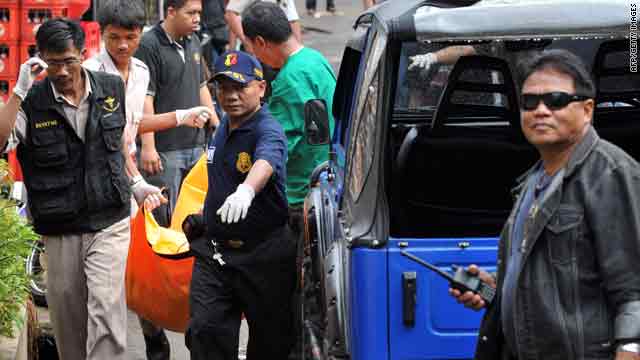
Jakarta, Indonesia (CNN) -- Indonesian authorities killed the suspected mastermind behind the deadly 2002 Bali bombings, Indonesian President Susilo Bambang Yudhoyono said on Wednesday.
Yudhoyono announced the death of terrorist Dulmatin while speaking with reporters during a visit to Australia. The Bali bombings killed 202 people.
"I can announce to you that, after a successful police raid against the terrorists hiding out in Jakarta yesterday, we can confirm that one of those that was killed was Mr. Dulmatin, one of the top southeast Asian terrorists that we have been looking for," Yudhoyono said.
Dulmatin, one of Indonesia's most wanted terrorists, had several aliases, including Joko Pitoyo. He was an electronics specialist who trained in al Qaeda camps in Afghanistan and had a $10 million bounty on his head, according to the U.S. State Department.
He was a senior member of the al Qaeda-linked terror network Jemaah Islamiyah.
Indonesian media had been reporting that Dulmatin was killed in a shootout in Pamulang, Banten province, on Tuesday.
The raid was linked to ongoing security sweeps in Aceh province in northern Sumatra. Police have arrested 15 suspected militants, and one has been killed. Three police officers have died in the raids.
Aceh Governor Irwandi Yusuf said that, for a year now, he has known about a militant training camp in the province. He said militants were seeking to establish camps similar to those run by Jemaah Islamiyah in the the southern Philippines.
The group has a stated goal of creating an idealized Islamic state comprising Indonesia, Malaysia, Singapore, the southern Philippines and southern Thailand, according to GlobalSecurity.org, a public policy Web site that provides background on defense issues.
Yusuf told reporters that militants chose Aceh because it is a predominantly Muslim province that imposes shariah, or Islamic, law and because a rebellion -- the Free Aceh Movement -- had taken root there.
Indonesia's current anti-terrorism efforts come just days before President Barack Obama's planned visit to the world's most-populous Muslim nation.

Followers

Product Cloud